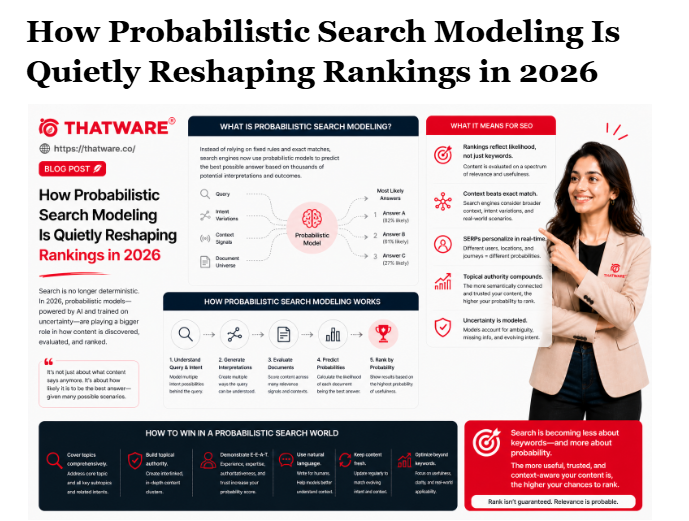

The dominant mental model for how search ranking works – a ranked list determined by a relatively stable set of weighted signals – has become increasingly inaccurate. Search ranking in 2026 is better described as probabilistic modeling: not a fixed answer to “what is the best result for this query” but a dynamic estimate of “what result is most likely to satisfy this specific user, in this specific context, at this specific moment.”
That distinction is subtle but its implications for SEO strategy are significant.
What Probabilistic Means in Practice
Traditional search ranking assumed that the best content for a query was approximately the same content for all users making that query. A page that ranked #1 for “best project management software” was the best page for that query, for everyone searching it.
Probabilistic ranking acknowledges that the best result varies by user context. The user’s location, device, prior search history, inferred industry or role, time of day – all of these context signals shift what the optimal result is. Two users making the same query at the same time may see different top results because the model estimates different optimal answers for their different contexts.
How This Changes SEO Strategy
For brands doingcanalysis, the probabilistic nature of modern ranking means that “what position are we ranking at” is a less useful question than “for which user contexts are we the model’s preferred answer?” Those are different measurements with different strategic implications.
A page that ranks #3 on average but #1 for the most commercially valuable user contexts (senior decision-makers, enterprise segment searches, high-purchase-intent signals) is a better performing page than one that ranks #1 on average but fails to win the most valuable audience segments.
The Role of Semantic Depth in Probabilistic Models
Semantic depth – comprehensive, authoritative coverage of a topic area – becomes more important in probabilistic ranking models than in traditional models, for an interesting reason. When the model is trying to estimate which result is best for a specific user context, it’s drawing on signals about what kind of content different user types tend to find valuable. Brands that have demonstrated consistent expertise across a topic area produce stronger signals for a wider range of user contexts.
Quantum SEO services that model this behavior can identify which user context segments a brand is winning and which it’s losing – and optimize content strategy to address the specific gaps rather than the aggregate average. That’s a more precise and efficient optimization target than chasing overall ranking position.
User Context Signals That Are Increasingly Influential
The specific signals that probabilistic models weight heavily in user context estimation are worth understanding. Search history signals (inferred expertise level, inferred stage in decision journey). Device signals (mobile search often indicates different intent than desktop for the same query). Time of day and week signals (informational queries at weekday midday often indicate professional research; same queries on weekend evenings often indicate personal curiosity). Geographic signals (local intent inferred from location proximity).
Optimizing for these context signals isn’t a traditional SEO tactic. It’s about producing content that’s genuinely better for specific user types – and then ensuring those user types can be served efficiently through clear site structure and internal linking.
What This Means for Measurement
Probabilistic ranking models create a measurement challenge. Average ranking position is an increasingly noisy signal. Impression share by device type, time of day, and geographic context tells a more accurate story about where a brand is winning and losing user contexts.
The brands that develop the analytical capability to measure performance across these context dimensions will make better optimization decisions than brands that continue to navigate by average position alone.